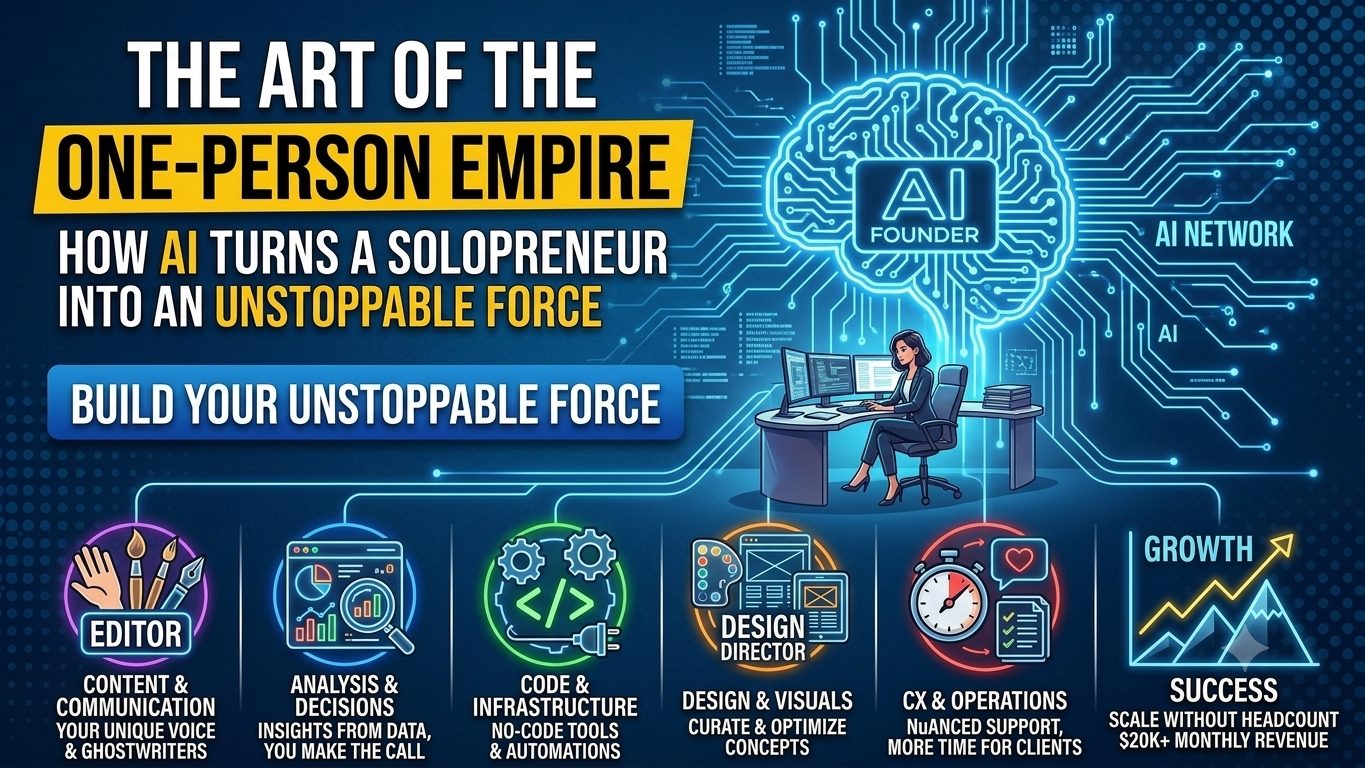
The Art of the One-Person Empire: How AI Turns a Solopreneur into an Unstoppable Force
Maya stared at her laptop screen in a quiet panic. It was 11 PM, and she had just landed her fifth freelance marketing client—a dream scenario for someone who had quit agency life only four months earlier to build a solo business. But the thrill curdled quickly. The onboarding emails, the content calendars, the data reports, the ad copy variations… they all demanded her attention at once. She wasn’t just the strategist anymore; she was the writer, the analyst, the designer, the project manager, and the person who still needed to eat lunch. That night, she did something that felt a little like admitting defeat but ended up becoming the most important business decision she’d ever make. She decided to treat AI not as a novelty, not as a chatbot, but as a silent partner—a co-founder who never sleeps, never complains, and scales without adding headcount.
Six months later, Maya was running a thriving one-person agency generating over $20,000 a month in revenue. Her secret wasn’t more hours. It was a fundamental rewiring of how she thought about work, leverage, and the role of intelligence—both human and synthetic—in a modern one-person business.
This is the story of that shift, and more importantly, how you can build your own one-person empire by treating AI as the ultimate force multiplier. It’s not about tools. It’s about a mindset, a series of systems, and a refusal to accept that doing everything yourself means doing everything alone.
The New Solopreneur Reality: Scale Without Employees
For decades, the narrative around building a business went like this: you start alone, you hustle, you hit a ceiling, and then you hire people to break through it. More people meant more complexity, management, and cost—but it was the only path. That equation has been shattered.
We’re now living in the era of the unscalable scalable business. A single person, armed with well-directed AI capabilities, can operate at the output level of a small team. Not in theory. In practice. The bottleneck is no longer the number of hands you have; it’s the clarity of your vision and your ability to orchestrate intelligence.
The real leverage of AI isn’t that it does work for you. It’s that it compresses the distance between an idea and its execution so dramatically that a solo founder can move faster than a traditional team of five.
Think about what used to take a week: drafting a market research report, designing a landing page, scripting and editing a product demo video, personalizing outreach emails for fifty leads, coding a custom integration between two apps. Each task demanded a specialist, or at least a very stretched generalist. Today, a single operator who knows how to direct AI can complete the same bundle of tasks before lunch—not perfectly, but iteratively enough that the speed of learning becomes the real competitive advantage.
This isn’t a utopian fantasy. It’s what happens when you stop thinking about AI as a vending machine for finished work and start seeing it as a raw material generator that you, the human, refine and assemble. The one-person business of 2026 isn’t a lonely freelancer drowning in to-do lists. It’s a micro-enterprise where the founder acts as the creative director, the quality gate, and the strategic brain, while AI handles the volume.
The Silent Partner You Didn’t Know You Had
To understand how this works in the real world, we need to move past the hype and get granular. Most people who fail to build a real business with AI make the same mistake: they try to replace themselves entirely. They ask an AI to “write a blog post” or “create a marketing strategy,” get back something generic, and decide the technology isn’t ready. That’s like hiring a brilliant but incredibly naive intern, giving them a vague one-line brief, and then firing them for not reading your mind.
The solopreneurs who win treat AI as a silent partner with a very specific set of superpowers: enormous knowledge breadth, infinite patience, and zero ego. Its weaknesses are equally clear: no lived experience, no taste, no true understanding of your specific customer’s emotional state. When you internalize that profile, you stop using AI to do your job and start using it to multiply your output across the five domains that matter most in a one-person business.
First, content and communication. Whether you’re a consultant, a creator, a SaaS founder, or an e-commerce seller, you live and die by your words. AI can draft ten variations of a product description, a welcome email sequence, or a LinkedIn post in seconds. But the magic happens when you, the human, inject the specific story, the unusual analogy, the personal anecdote that makes it yours. You’re not a writer anymore; you’re an editor with an army of ghostwriters.
Second, analysis and decision support. A one-person business generates a staggering amount of data: customer feedback, sales numbers, website analytics, competitive moves. Without a team, that data usually sits unexamined. Now you can feed raw information to an AI and ask it to surface patterns, write a plain-English summary, or even role-play a customer segment reacting to your new offer. You still make the final call, but you make it with insights that previously required a junior analyst.
Third, code and technical infrastructure. The most dramatic shift has been for non-technical founders. Things that once required hiring a developer on Upwork and waiting two weeks—building a simple internal tool, scraping data from a website, automating a multi-step workflow—can now be done in an afternoon through iterative conversation. You don’t need to learn to code; you need to learn to specify precisely and test relentlessly. The AI writes the code, you verify the outcome.
Fourth, design and visual assets. Need a hero image for a blog, an icon set for a dashboard, or a storyboard for a short video ad? The capability exists to generate, iterate, and refine visuals without ever opening a complex design tool. Again, the output isn’t final. It’s a starting point that you curate, combine, and tweak until it matches the vision in your head. Design becomes a dialogue, not a specialized craft you outsource.
Fifth, customer experience and operations. This is the quiet engine of the one-person business. Drafting personalized onboarding materials, answering common support questions with nuance, generating a summary of a 30-minute client call from a transcript—all of this absorbs hours that could be spent on high-value strategy. By offloading the cognitive load of these operational tasks, you reclaim the mental space to be present with clients and think about the bigger picture.
! Important: The goal is never to publish AI output untouched. That’s the fastest route to mediocrity and brand erosion. The goal is to reduce the activation energy for every task so low that starting becomes effortless. When the blank page is already filled with a competent draft, your brain shifts from “I have to create this from nothing” to “How can I make this excellent?” That psychological shift is worth more than any time saved.
The Case of the Accidental Agency Owner
Let’s ground this in a concrete example. Consider a real pattern I’ve seen repeatedly in the last year: the accidental agency owner. Alex was a mid-level product manager who got laid off and decided to offer “product strategy consulting” to early-stage startups. He set up a simple website, posted on LinkedIn, and within two weeks had three small clients. The work was fascinating, but the business was a mess.
Client A wanted a competitive landscape analysis. Client B needed a go-to-market narrative for investors. Client C had a messy pile of user feedback and wanted a prioritized feature roadmap. In a traditional setup, Alex would have spent 60% of his time on research and documentation—digging through CrunchBase, reading app store reviews, formatting slide decks—and only 40% on the high-leverage strategic thinking that clients actually paid for.
Instead, Alex built a system. For the competitive analysis, he directed AI to gather and synthesize publicly available information on five named competitors, then cross-reference that with recent news and product updates. The output wasn’t a finished deliverable, but it gave him a 70%-complete landscape map in twenty minutes. He spent the next two hours adding his own framework—a mental model he’d developed over years—and turning the raw data into a narrative about market gaps. The deliverable looked like something a two-person strategy team would produce in a week. The client was blown away, not by the AI, but by the depth and speed. They never saw the process; they saw the result.
For the go-to-market narrative, Alex used a different tactic. He recorded a 15-minute voice memo of himself thinking out loud about the product, the audience, and the messy, half-formed story in his head. He fed that transcription to an AI and asked it to shape the stream-of-consciousness into a structured narrative with a clear arc. What came back wasn’t brilliant, but it had removed the friction of structuring. Alex then rewrote large sections in his own voice, injecting the emotional hook he knew would resonate. The AI had acted as a thought partner who organized his chaos.
The lesson from Alex’s story isn’t about which tool he used. It’s about the workflow: human seed, AI expansion, human refinement. The seed is your unique insight, experience, or creative spark. The expansion is AI’s ability to run in a hundred directions at once, filling in the blanks. The refinement is your taste, judgment, and emotional intelligence, which are irreplaceable. When you build a business around this loop, you stop trading time for money and start trading taste for money.
The Biggest Mistakes That Keep Solopreneurs Stuck
I’ve watched dozens of talented people attempt this model and fail quietly. Their failures aren’t usually about picking the wrong technology. They fall into a few predictable traps that are worth examining because they’re entirely avoidable.
The first trap is premature automation. There’s a seductive allure to connecting everything with invisible workflows before you’ve validated that a single human can sell the service at a profit. People spend three weeks building an AI-powered onboarding sequence for a product that has zero customers. The sequence is beautiful; the business is dead. You don’t need to automate a process that doesn’t exist yet. In the beginning, do things manually, even if it’s slow. Feel the friction in your own hands. Only automate the pieces that you’ve proven are repeatable and valuable. Automation amplifies what’s already working. It doesn’t create value from nothing.
The second trap is what I call output grazing—endlessly generating variations without ever making a final call. AI makes it so easy to produce ten headlines, fifteen logo concepts, eight versions of a sales email that you can get lost in the infinite gallery of options. You spend hours tweaking prompts, chasing a slightly better version, and at the end of the day, you’ve shipped nothing. I once met a solopreneur who spent two days generating 47 different taglines for her coaching website. She never chose one because none felt “perfect.” Meanwhile, a competitor with a rough, human-wrought tagline had already started conversations with her ideal clients. Real business momentum comes from making decisions and putting things into the world, not from curating an ever-expanding set of drafts. The most successful AI-powered solopreneurs use a strict timer: generate, pick the best one, edit aggressively, and ship. Speed of iteration beats perfection of generation every single time.
The third trap is losing the human signal. When every touchpoint starts to feel like it was written by a very articulate robot, trust erodes. I saw this happen to a solo founder who built a highly successful paid newsletter. In month one, she poured her voice into every issue, and subscribers loved it. As she grew, she leaned more on AI to maintain volume, and over the course of three months, the newsletter became smoother, more grammatically perfect, and completely soulless. Subscriber engagement dropped, and unsubscribes rose. She hadn’t changed the topic; she’d removed the texture of a real human thinking out loud. The fix wasn’t to stop using AI; it was to intentionally inject more of her own stories, spontaneous observations, and even occasional hot takes that an AI would never generate because they were slightly too raw or personal. That’s the signal. The AI can build the stage, but you have to be the one on it.
The fourth trap is scope creep on the idea itself. AI makes you feel capable of anything, which paradoxically can lead you to build a business that does everything for everyone. You start a boutique content studio, but then you realize you can also do branding, and then maybe some light web development, and soon your offering is so broad that no one knows what you stand for. In a one-person business, clarity is your only real moat. AI can execute across domains, but your positioning must remain sharp. I worked with a consultant who niched down from “I help startups” to “I help health-tech founders who hate fundraising build investor narratives in 7 days.” The specificity felt terrifying, but it tripled her close rate because she became the obvious choice for a very specific pain. The most powerful phrase in the solo founder’s vocabulary is “I specialize in…” When you try to be an everything store powered by AI, you compete with every generalist freelancer on the planet. When you are the world’s expert in a very narrow, AI-amplified niche, you become irreplaceable.
Mistake Pattern: The common thread in all these traps is that founders treat AI as a substitute for strategic thinking rather than a lever for it. They automate before they understand, generate before they decide, and scale the generic before they’ve protected the specific. The fix is always to return to first principles: What unique value do I bring? What does my specific customer actually need? Where is the signal that makes this unmistakably mine?
Building the System: A Day in the Life of an AI-Amplified Solopreneur
What does it actually feel like to run a business like this, day to day? It’s quiet. It’s intentional. It’s nothing like the frantic, caffeine-fueled stereotype of startup culture.
Imagine Priya, a solo founder who runs a business helping niche B2B software companies produce technical case studies and white papers. She has seven active clients, each paying a monthly retainer. Her days aren’t spent writing from scratch. She starts her morning by reviewing the transcript of a client interview she conducted the previous day. The raw transcript is messy—umms, tangents, brilliant quotes buried in jargon. She passes it to her AI system with a very specific set of instructions: extract the three most compelling customer quotes, outline a narrative arc that mirrors the classic “challenge-solution-result” structure, and flag any claims that would need numerical proof. In ninety seconds, she has a skeleton. She spends the next hour listening back to key moments from the recording, letting the actual human voice—the pauses, the emphasis—guide how she builds the story. The AI gave her the bones; she adds the flesh.
Midday, she handles client communication. She’s not firing off quick sloppy emails. For each client, she dictates a voice memo on her walk, covering updates, next steps, and a personal note. The AI transcribes, expands her bulleted thoughts into complete, warm emails, and even drafts subject lines. Priya then reads each one, makes small edits to ensure it sounds like her—sometimes adding an inside joke from a previous call—and sends. She’s communicated deeply with seven clients in twenty-five minutes, something that would have taken two hours of careful typing. But crucially, the seed of each email came from her spoken words, her tone, her real-time thinking. The AI was a translator between her thoughts and the page.
By afternoon, she focuses on growth. She wants to test a new offer: a shorter “micro case study” format for a different market segment. In the old world, she’d have to write the sample herself, design a landing page, and agonize over it for days. Instead, she uses AI to generate five variations of the sample based on a detailed brief she wrote. She picks one, heavily rewrites the introduction and conclusion, and has a draft ready in an hour. For the landing page, she describes the layout she wants—hero, three benefits, a testimonial, a form—and gets back a clean structure and first-draft copy. She swaps in a real testimonial from a client, adjusts the headline to be more specific, and publishes it on a simple no-code page. The whole experiment takes an afternoon. It’s not perfect, but it’s live, and she’ll learn from real traffic rather than from her imagination.
This isn’t a fantasy. It’s a discipline. The key is that Priya never surrenders the role of director. She makes hundreds of micro-decisions every day: this tone, not that one; this angle, not that one; this client needs more warmth, that one needs more precision. The AI executes, but she’s the one with taste. Her business doesn’t feel automated to her clients. It feels remarkably attentive, personal, and fast. That’s the paradox of well-applied AI: when used correctly, it makes the business feel more human, not less, because the founder now has the bandwidth to focus on the details that convey real care.
The Personal Reality Check: What Nobody Tells You
Before you quit your job and decide that a one-person AI empire is your destiny, there’s a deeper, more personal dimension that rarely gets discussed. Running a business alone, even with a synthetic partner, amplifies your psychological patterns. If you have a tendency toward perfectionism, AI can become an endless procrastination engine. If you struggle with impostor syndrome, you might find yourself attributing your success entirely to the AI, which erodes your confidence and your ability to charge what you’re worth. If you’re prone to overwork, the lack of human collaborators to tell you to stop can lead to a 24/7 cycle of refining outputs and checking dashboards.
I’ve seen solopreneurs burn out not because they had too much to do, but because they never gave themselves permission to stop doing. When AI removes the natural stopping points—finishing a design, sending an email draft to a colleague for review, waiting on a developer—the work stream becomes continuous. You can always generate one more variation, analyze one more data set, optimize one more funnel step. The business becomes a treadmill that never turns off. One founder I know described it as “the curse of infinite possibility”: every night he’d close his laptop feeling like he’d barely made a dent in what could be done, because the AI was always ready for another round. His revenue grew, but his sleep didn’t.
The healthiest AI-powered founders I know build deliberate human touchpoints into their week. They join a small mastermind group of other solopreneurs. They schedule calls with mentors not because they need tactical advice, but because they need to hear another human voice reflect their thinking back to them. They have a ritual for ending the day that doesn’t involve a screen—a walk without headphones, a physical book, a conversation with a friend that has nothing to do with business. They recognize that the greatest risk of the one-person business isn’t failing to scale; it’s losing yourself in the infinite possibility that AI offers.
This isn’t just wellness advice. It’s a business continuity plan.