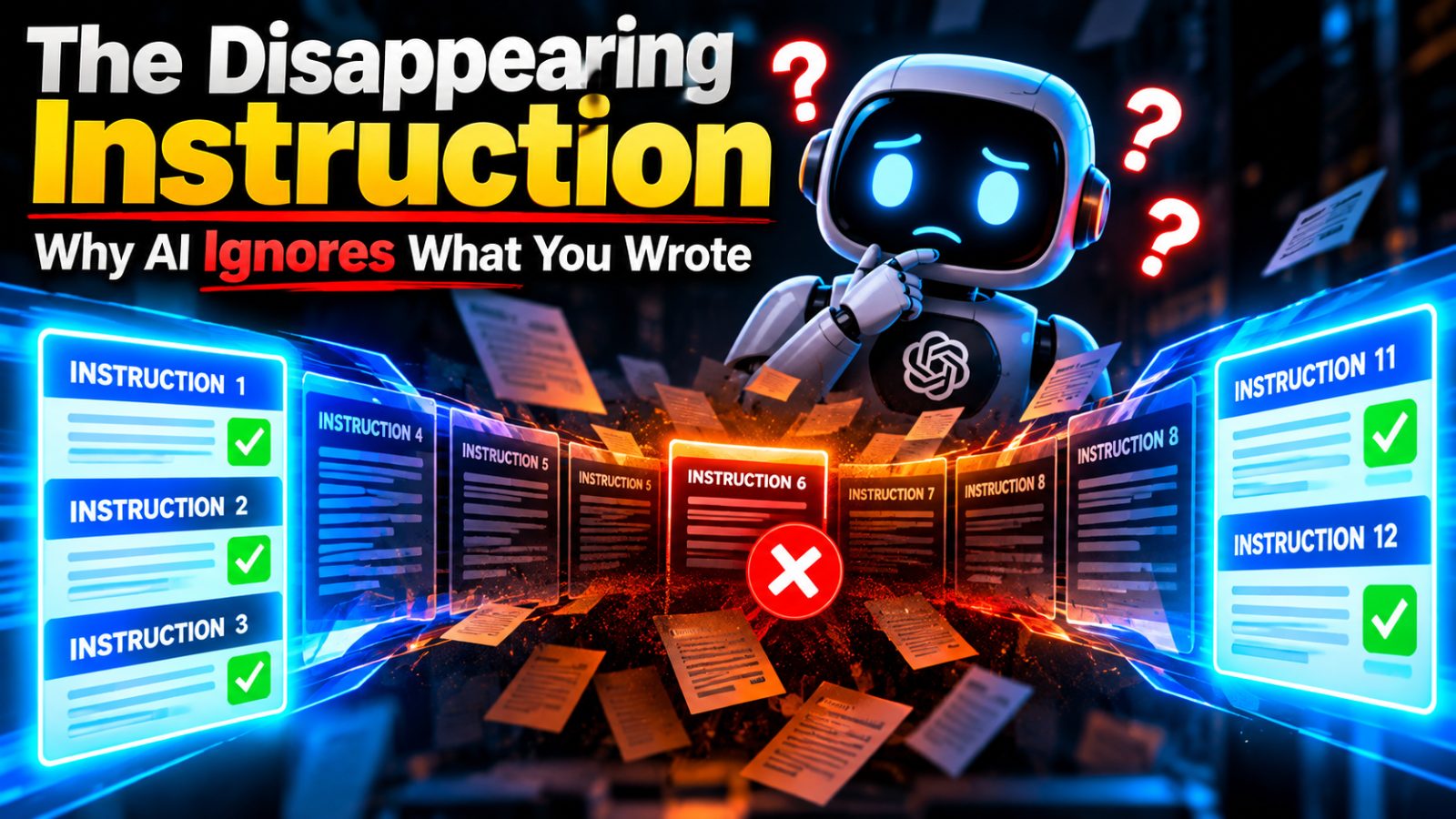
The Disappearing Instruction: Why AI Ignores What You Wrote
If you have ever spent hours building a detailed system prompt, fine-tuning an autonomous agent, or feeding multi-page research documents into a language model, you have almost certainly encountered this baffling failure:
You craft a comprehensive prompt containing twelve specific operational rules. When the model generates its response, it executes Rule 1 flawlessly, adheres strictly to Rule 12, but completely ignores Rule 6.
Frustrated creators assume the model is malfunctioning, that the provider quietly updated the weights, or that the AI is simply not smart enough to follow complex logic.
The truth is grounded in the fundamental mathematical architecture of transformer neural networks: you placed your critical instruction in the cognitive dead zone of the context window.
This phenomenon is known as the Lost in the Middle effect.
According to seminal research published in Stanford NLP's Research on Lost in the Middle, language model performance is not uniform across a prompt. When critical facts or operational constraints are placed in the middle of a context window, retrieval and reasoning accuracy can plummet by up to 40 percent, regardless of the model's overall intelligence.
The Science of "Lost in the Middle": The U-Shaped Attention Curve
To understand why models overlook middle instructions, look at how transformer attention mechanisms process sequences of tokens.
When a language model calculates attention weights across a long input stream, its cognitive focus forms a distinct U-shaped curve:
The Primacy Effect (First Impressions Matter)
The model pays disproportionate attention to the very beginning of the prompt (the first 10 to 15 percent of tokens). Tokens placed at the start anchor the model's global attention matrix, setting the initial persona, domain boundaries, and conceptual tone.
The Recency Effect (Last Words Linger)
The model pays immense attention to the absolute end of the prompt (the final 10 to 15 percent of tokens). Because autoregressive models generate tokens based on the immediately preceding context, instructions sitting directly above the completion point exert overwhelming local influence.
The Valley of Neglect (The Dead Zone in the Middle)
In the vast middle expanse of the prompt (between 20 and 80 percent of the token window), attention density sags significantly.
As the token count climbs, the mathematical attention budget becomes diluted across thousands of competing word pairs. Information placed in this middle trough is easily drowned out by surrounding background noise, causing models to drop constraints or fail to retrieve specific facts.
As detailed in the PromptMastery Guide on Instruction Enclosure, human psychology exhibits a similar serial-position effect: humans remember the first and last items on a grocery list while forgetting the items in between. Transformers inherit this exact cognitive quirk.
"Language model performance is highest when relevant information occurs at the very beginning or end of the input context, and degrades significantly when models must access relevant information in the middle of long contexts." — Stanford NLP Group
The 1-Million-Token Illusion: Why Bigger Context Didn't Fix It
When foundation model labs announced context windows expanding to one million and two million tokens, many developers assumed the attention problem was solved forever.
In practice, expanding the context window merely expanded the size of the dead zone:
- Standard Needle in a Haystack benchmark tests evaluate simple string retrieval—asking a model to find a single, distinct phrase deliberately planted inside random text. Models pass this test easily.
- Real-world tasks do not require simple retrieval; they require reasoning across context. The model must synthesize multiple rules, weigh constraints against each other, and produce a nuanced answer.
- On deep reasoning tasks, placing critical instructions in the middle of a 200,000-token prompt causes the exact same attention collapse observed in smaller 8,000-token models.
Relying on a massive context window without optimizing where information sits is like buying a massive warehouse and tossing your keys somewhere in the middle of the dark floor.
The 4 Prompt Architectures That Defeat Attention Degradation
To ensure your critical instructions and reference facts are executed reliably every single time, elite prompt engineers employ four proven architectural patterns:
1. The Sandwich Prompting Pattern (Instruction Enclosure)
The single most effective defense against attention sag is instruction enclosure, commonly known as Sandwich Prompting:
- Top Layer (Primacy Anchor): State your overarching objective, persona guidelines, and primary execution rules at the very top of your prompt template.
- Middle Layer (The Passive Data Meat): Place all heavy, variable reference materials—such as retrieved RAG passages, customer conversation history, raw transcripts, and code files—in the middle section.
- Bottom Layer (Recency Reinforcement): Conclude the prompt with an explicit constraint recap. Repeat your three or four most vital negative constraints, formatting rules, and final instructions directly beneath the reference data, immediately preceding the generation point.
By enclosing passive data between two active instruction layers, the model is primed at the start and forcefully reminded right before it generates its first token.
2. U-Shaped RAG Reranking (Burying the Least Important Data)
When building Retrieval-Augmented Generation (RAG) pipelines, standard systems insert retrieved chunks in simple descending order of search score (Rank 1, Rank 2, Rank 3... Rank 10).
This places Rank 5 and Rank 6 directly in the dead center of the context window.
High-performance retrieval systems reorder retrieved snippets into a U-shaped distribution:
- Place your highest-scoring snippet (Rank 1) at the very beginning of the reference block.
- Place your second-highest snippet (Rank 2) at the very end of the reference block.
- Alternate inward, placing your weakest, lowest-priority snippets in the middle.
- This ensures that if the model's attention sags in the center, it misses only low-confidence background data rather than your primary source material.
3. Structural XML Delimiters and Landmark Tags
Language models struggle when instructions and data blend together into uniform prose. Structural delimiters create distinct visual and semantic boundaries that attention heads can latch onto:
- Wrap reference data inside clear structural tags, such as dedicated XML containers.
- Use explicit landmark labels: assign distinct IDs or categorical headers to individual sections.
- When referencing a rule in your final prompt instructions, cite the exact tag container: Adhere strictly to the negative constraints defined in the operational rules block above.
4. Aggressive Context Pruning and Radical Minimization
The simplest way to eliminate attention degradation is to reduce the distance between the start and end of your prompt:
- Remove conversational pleasantries, boilerplate email headers, decorative HTML tags, and redundant examples from your context before passing it to the model.
- Pruning 30 percent of non-essential background text naturally pulls middle instructions closer to the active recency window, immediately restoring reasoning accuracy.
Diagnosing Your Own Prompts: The Placement Audit
If an existing AI assistant or workflow is intermittently dropping instructions, run this quick placement audit:
- Where is the ignored rule currently located? If it sits in paragraph four of an eight-paragraph prompt, move it to the final three lines.
- Are you expecting the model to remember a negative constraint stated only once at the top of a 4,000-word prompt? Duplicate the rule in a concise closing reminder.
- Does your prompt interleave instructions with reference documents? Separate them cleanly: instructions first, reference data enclosed, checklist last.
Mastering Attention: The True Mark of Senior Prompt Engineering
In the early days of generative AI, prompt engineering was treated as an exercise in vocabulary—finding the right synonyms or polite framing to coax an answer from a model.
Today, advanced prompt engineering is an engineering discipline grounded in attention optimization.
Models do not fail because they are malicious or broken; they fail because human creators ignore the physical dynamics of the context window.
By structuring prompts with sandwich enclosures, optimizing RAG snippet placement for U-shaped attention, and pruning conversational clutter, builders can transform erratic models into deterministic, enterprise-grade systems that execute every instruction flawlessly.
To explore more technical prompt architectures, practical workflows, and production guides for modern AI builders, visit the Promzen Blog.