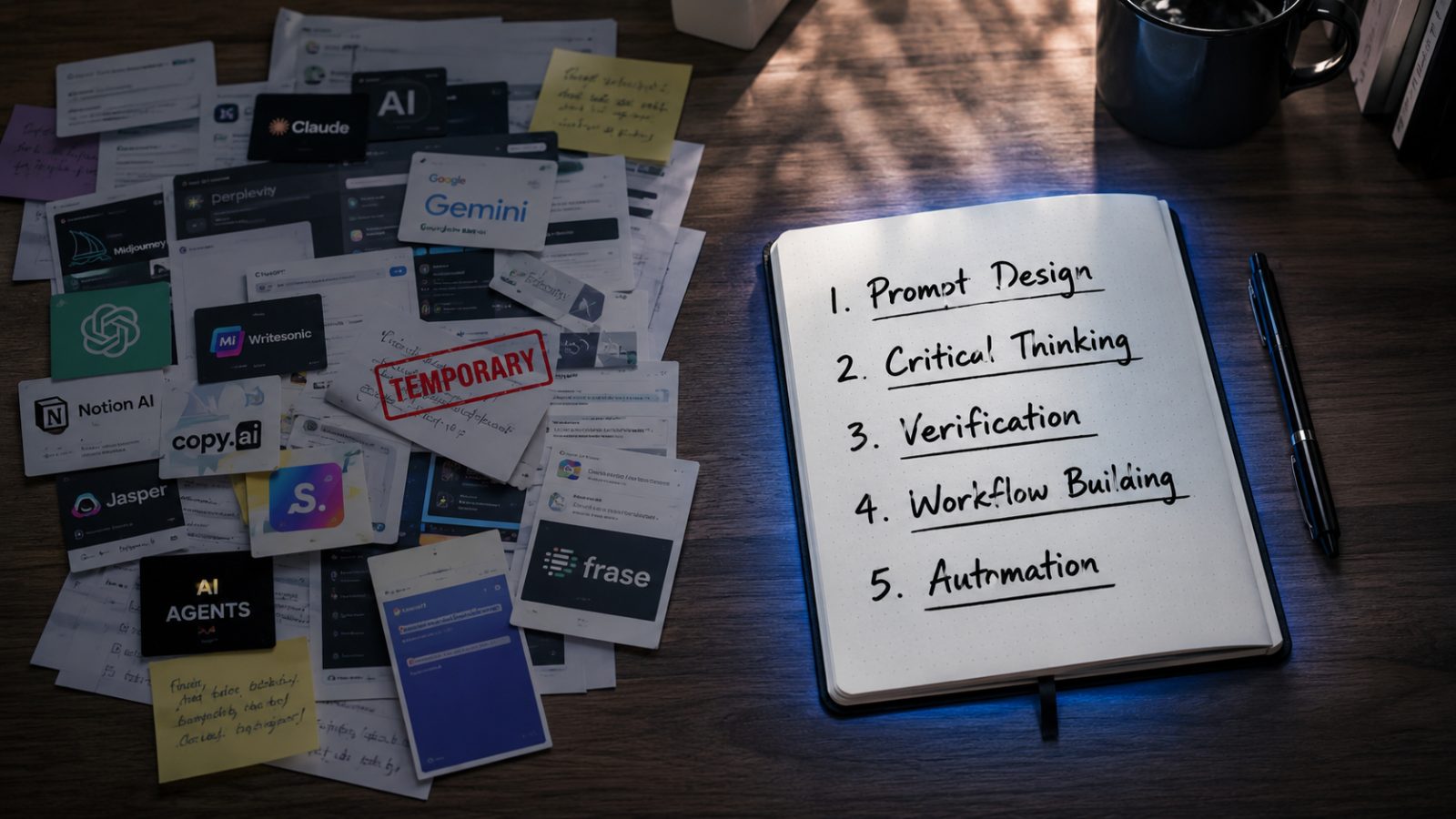
AI Skills vs AI Tools: Why Skills Will Always Win
Every month, a new AI tool goes viral.
One week it's ChatGPT. The next week it's Gemini, Claude, Grok, or another AI assistant. New image generators, coding assistants, research tools, and automation platforms appear constantly.
Many people believe success comes from using the newest AI tool.
The reality is different.
The people getting the best results aren't chasing every new tool—they're building AI skills that work across every platform.
If you understand how to think, verify information, design prompts, and build workflows, switching from one AI tool to another becomes easy.
That's why AI skills are becoming more valuable than AI tools.
AI Skills vs AI Tools
Think of AI tools like smartphones.
Every year, new phones are released with better cameras, faster processors, and new features. But owning the latest phone doesn't automatically make someone a better communicator, designer, or entrepreneur.
AI works the same way.
New AI tools appear almost every month. Some become popular, while others quickly fade away. If you spend all your time chasing the newest tool, you'll constantly need to start over.
AI skills are different. They stay valuable regardless of which platform you use. Whether you're using ChatGPT, Gemini, Claude, Grok, or another AI assistant, the ability to write clear prompts, think critically, verify information, build efficient workflows, and automate repetitive tasks remains the same.
Learning only one AI tool is like learning to drive one specific car.
Learning AI skills is like learning how to drive itself—you can adapt to almost any vehicle with confidence.
That's why investing in AI skills is a smarter long-term strategy than focusing only on the latest AI tools.
Five AI Skills That Matter Most
1. Prompt Design
The quality of your AI output depends heavily on the quality of your instructions.
Instead of writing:
"Write a blog."
Try:
"Write a 1,500-word beginner-friendly SEO blog for entrepreneurs. Use simple English, practical examples, headings, FAQs, and a friendly tone."
Good prompts provide:
- Clear goals
- Context
- Target audience
- Desired format
- Tone
- Constraints
Prompt engineering isn't about memorizing tricks—it's about communicating clearly.
2. Critical Thinking
AI sounds confident even when it's wrong.
That's why critical thinking is becoming one of the most valuable future skills.
Always ask:
- Does this answer make sense?
- Is there evidence?
- Is something missing?
- Are there alternative viewpoints?
AI should support your thinking—not replace it.
3. Verification
Never assume AI is always correct.
Before publishing or making important decisions:
- Verify statistics.
- Check dates.
- Confirm names.
- Read original sources.
- Compare multiple references.
Professionals who verify information build trust.
4. Workflow Building
High-performing users don't ask AI one question.
They create systems.
Example workflow:
1. Research ideas with AI.
2. Organize notes.
3. Generate an outline.
4. Write the first draft.
5. Edit for clarity.
6. Optimize for SEO.
7. Publish.
8. Repurpose into social media posts.
The workflow creates consistency, regardless of which AI tool you use.
5. Automation
Automation helps you save time by letting AI handle repetitive work.
Examples include:
- Content planning
- Email drafting
- Meeting summaries
- Data organization
- Customer support responses
- Research collection
The goal isn't to replace human creativity—it's to free up more time for meaningful work.
Common Mistakes
Many beginners slow their progress by making these mistakes:
Learning every new AI tool
New tools appear constantly. Instead of trying them all, master the core skills that work everywhere.
Copying prompts without understanding them
A prompt is only useful if you know why it works. Focus on the reasoning behind the structure.
Trusting AI blindly
AI can make mistakes. Verify important facts before using them.
Ignoring domain knowledge
AI performs best when paired with real expertise in business, education, design, programming, marketing, or another field.
Expecting instant results
Like any skill, becoming effective with AI takes practice and experimentation.
AI Learning Roadmap
If you're just getting started, follow this progression:
Step 1: Learn the basics
- Understand how large language models work at a high level.
- Explore different AI use cases.
Step 2: Practice prompt engineering
- Write prompts daily.
- Compare different prompt styles.
- Improve clarity and specificity.
Step 3: Learn verification
- Fact-check AI responses.
- Use reliable sources.
- Build good research habits.
Step 4: Build workflows
- Combine AI with your existing tasks.
- Document repeatable processes.
Step 5: Add automation
- Identify repetitive work.
- Use AI features or automation tools where appropriate.
- Measure the time you save.
Continue improving these skills, and you'll be able to adapt to new AI tools as they emerge.
Final Thoughts
AI tools will continue to evolve rapidly.
Some will disappear.
Others will become industry standards.
But the underlying skills—clear communication, critical thinking, verification, workflow design, and automation—will remain valuable regardless of which platform is popular.
Instead of asking, "Which AI tool should I learn next?"
Start asking,
"Which AI skill should I improve next?"
That shift in mindset will prepare you for the future of work.
Frequently Asked Questions
Are AI skills more important than AI tools?
Yes. Tools change quickly, while skills like prompt design, verification, and critical thinking remain useful across different AI platforms.
What is the most important AI skill?
Prompt design is a strong starting point, but combining it with critical thinking and verification leads to better long-term results.
Can beginners learn AI without coding?
Absolutely. Many valuable AI skills—such as writing effective prompts, evaluating outputs, and building workflows—do not require programming knowledge.
Which AI skills are useful for careers?
Prompt engineering, critical thinking, verification, workflow building, automation, communication, and domain expertise are all valuable across many industries.
Practice AI Skills with Promzen
Reading about AI is only the first step.
The fastest way to improve is by practicing with high-quality prompts, experimenting with different workflows, and learning from real examples.
Explore curated prompts, discover practical use cases, and build stronger AI skills with Promzen.