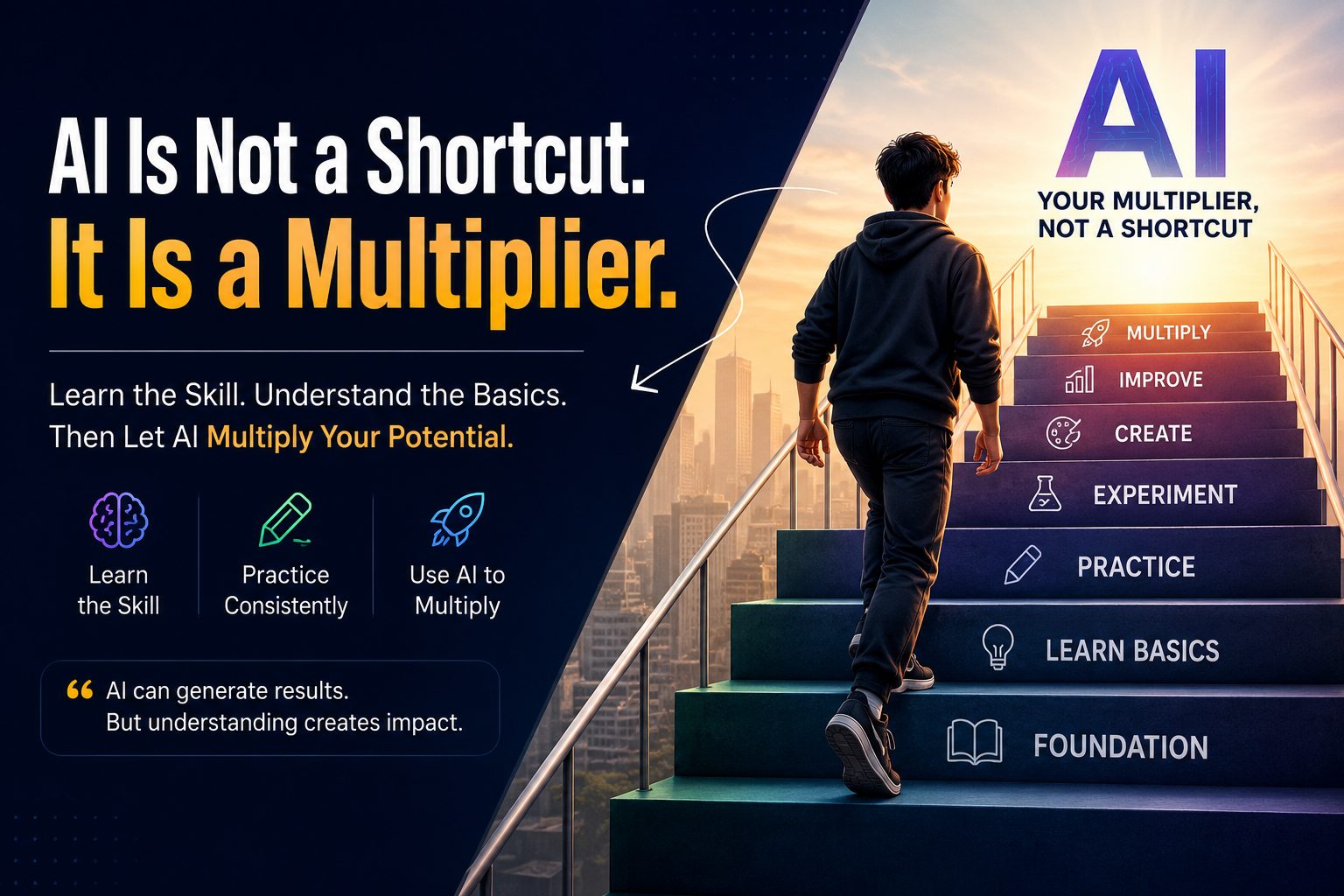
AI Is Not a Shortcut. It Is a Multiplier
Stop learning prompts. Start learning the craft.
The Dangerous Promise of Instant Expertise
We live in a time of digital wonder. You can type a few words and get a full article. Describe a scene and a photorealistic image appears. Artificial intelligence has made creative work faster than ever. It feels like anyone can become a designer, writer, or developer overnight.
But a quiet problem is growing. A false belief has taken root. Many people now think they do not need to learn the basics. They believe AI will handle everything. This idea is not true. It is a trap that can limit your growth forever.
AI is not a ladder that lets you skip steps. It is a multiplier. And a simple math truth is this. Anything multiplied by zero is still zero.
Knowledge without understanding is like a car without a driver. It looks ready, but it goes nowhere meaningful.
Skill is the foundation. AI is the engine. If the foundation is weak, the engine only creates noise. It does not create meaningful progress.
The Chef and the Knife
Imagine two chefs standing in a kitchen. Both have the same expensive and sharp knife.
The first chef has trained for many years. She knows exactly how heat changes food. She understands how flavors balance each other. She can feel when a dish is cooked perfectly. The sharp knife is simply an extension of her hand. She uses it to work faster and more precisely. The tool multiplies her mastery.
The second chef has never cooked before. He buys the same expensive knife. He tries to cut vegetables. The pieces come out uneven. Some are too thick. Some are too thin. They do not cook at the same speed. The final dish looks messy and tastes bad. The knife did not make him a chef. It just gave him a sharp edge without any control.
AI is exactly like that knife. It can perform technical tasks at great speed. But it cannot taste the food. It does not understand why a color feels warm and welcoming. It cannot explain why a sentence brings tears to your eyes. AI has no lived experience. It has no emotional weight to share. That part, the soul, the judgment, the taste, must come from you.
A tool in the hands of a master multiplies art. A tool in the hands of a beginner multiplies mistakes.
The Trap of the Perfect Prompt
There is a new kind of procrastination spreading fast. It looks like hard work. It feels like learning. But it is actually a dead end.
This is the endless search for the perfect prompt.
Scroll through any online community today. You will see thousands of posts promising magic words. Courses sell the idea of mastering image tools in seven days. People spend hours copying and pasting prompts. They believe the secret to great work is hidden inside a secret combination of words.
But here is the uncomfortable truth. If you do not know what good work looks like, you will not recognize it when the AI hands it to you.
Imagine you ask AI to write an important social media post. It gives you five different versions.
- One version is full of boring clichés.
- One version has a clear logical mistake.
- One version is pure fluff with no substance.
- One version is actually sharp and clear.
- One version is okay but feels robotic.
Without a real understanding of writing and communication, which one will you choose? Most beginners choose the version that sounds the smartest. They do not choose the one that truly connects with people. You become a curator of mediocrity instead of a creator of value.
Soon you hit a wall. You can generate a hundred ideas in ten minutes. But none of them feel quite right. And you lack the basic skills to fix them. You start blaming the tool. You switch to another AI. You search for even better prompts. But the real bottleneck is the absence of a trained human mind.
The Multiplier Mindset
What is the correct way forward? Should we reject AI and do everything manually?
No. That would be like burning a calculator because you want to practice mental math.
The goal is to adopt the Multiplier Mindset. This mindset rests on a very simple equation.
Fundamental Skill × AI Amplification = Exponential Output
Notice the order carefully. You do not start with the amplification. You build the skill first. Then you layer AI on top to break your old limits completely.
- A designer who truly knows layout, color, and typography can use AI to generate fifty layout variations in minutes. She scans the results with a trained eye. She spots a clever use of space. She notices a bold contrast. These are details a beginner would completely miss. She pulls those ideas into her work and creates something extraordinary.
- A writer who understands story structure and emotional pacing uses AI to defeat blank-page fear. She does not ask the AI to write the final story. She asks it to give her ten unexpected metaphors for loneliness. Or she asks it to challenge her argument from three different angles. The AI becomes a thinking partner, not a replacement.
- A musician who knows harmony and rhythm can feed an AI a rough melody. The AI gives back orchestration ideas. The musician listens, selects, and refines. The machine saves hours of trial and error. The final art remains deeply human.
AI does not replace your creativity. It simply buys you more time to be truly creative.
Why Fundamentals Are Your Real Superpower
If AI can do so much, why should you bother learning the hard skills? Because those hard skills are exactly what make your work stand out. Here is what deep understanding gives you that prompts can never provide.
- Taste. You can tell the difference between beautiful and ugly. You know what is meaningful and what is shallow.
- Problem-Solving. When the AI gives you something that is eighty percent correct, you know exactly how to fix the remaining twenty percent.
- Originality. You are not limited to remixing what the AI has already seen. You bring your own life, pain, joy, and unique perspective.
- Speed of Judgment. You do not waste hours tweaking prompts endlessly. You know instantly what will work and what will fail.
Let us make this idea very concrete. Imagine you need to create a logo for a new coffee shop. A beginner types a simple prompt. The AI gives back a few generic cup icons. The beginner picks one that looks nice. But the logo feels flat and empty. It says nothing meaningful.
A skilled designer thinks in a completely different way.
- She first asks about the shop's personality. Is it warm and rustic? Is it sleek and futuristic?
- She thinks about shapes. Round shapes and earthy colors convey warmth.
- She searches for hidden messages. Maybe the steam from the coffee can form a subtle heart shape.
The designer then uses AI to rapidly sketch variations based on these deeper ideas. The final result tells a memorable story. It stays in your mind. That is the powerful difference real skill makes.
A Practical Path to Follow
How do you build this multiplier mindset in your own life? Follow this simple and practical path.
Step One: Choose One Skill
Do not try to learn everything at once. Pick one skill that you truly care about. It could be writing, design, coding, video editing, or marketing.
Step Two: Learn the Core Principles Without AI
Spend dedicated time learning the fundamentals deeply.
- If you choose writing, study headlines, structure, persuasion, and storytelling.
- If you choose design, learn color theory, typography, layout, and visual hierarchy.
- If you choose coding, understand logic, data structures, and how to break down problems.
Do exercises by hand. Write headlines on paper. Sketch layouts with a pencil. Write code without autocomplete. This struggle builds the neural pathways that separate professionals from prompt typers.
Step Three: Practice Every Single Day
Consistency always beats intensity. Just fifteen minutes of deliberate practice every day will build a rock-solid foundation. Create small projects constantly. Fail often. Learn deeply why something does not work.
Step Four: Introduce AI as Your Assistant
Once you can produce good work completely on your own, bring in the AI.
- Use it to brainstorm ideas faster.
- Use it to generate rough drafts that you then improve.
- Use it to handle repetitive tasks like resizing images or checking basic grammar.
- Use it to challenge your ideas and assumptions.
You are now multiplying your existing skill, not masking its complete absence.
Step Five: Refine and Reflect Constantly
Always compare your AI-assisted work with your manual work. Ask yourself if it is truly better. Keep a journal of what the AI does well and where it falls short. Your critical eye will sharpen significantly over time.
The master does not fear the tool. The master uses the tool to become more of what they already are.
The Future Belongs to Hybrid Creators
The world is now splitting into two distinct groups.
The first group treats AI as a complete replacement for learning. They chase prompts and shortcuts endlessly. Their work looks shiny on the surface but completely lacks depth. They hit a ceiling very quickly because their tool cannot grow beyond its training data.
The second group treats AI as an amplifier of deep human skill. They understand their craft inside and out. They use AI to move faster and test bolder ideas. Their work has real substance, soul, and innovation. They keep growing because their foundation is genuinely human.
Which group will you choose to join?
Companies are already waking up to this reality. They have seen thousands of generic AI-generated portfolios. They are now hungry for people who bring real judgment and authentic taste. A person who knows design principles and can skillfully guide AI will always be hired. The demand is growing for true hybrid creators.
What to Ask Yourself Today
If you are starting your creative journey today, do not ask these questions.
- How can AI do everything for me?
- What prompt will make me successful?
- Which AI tool should I learn first?
Ask yourself these questions instead.
- What skill do I truly want to master?
- How can I practice that skill today without any shortcuts?
- Once I am confident, how can AI help me become even better?
That single shift in thinking changes everything. It turns AI from a crutch into a powerful rocket booster. It moves you from being a passive consumer of generated content to an active creator of meaningful work.
A Final Reminder
AI is not the top step of success. It is the gear that helps you climb faster after you actually start climbing.
- Learn the real skill first.
- Practice it consistently every day.
- Then let AI multiply your dedicated effort.
The calculator did not make mathematicians useless. It made them capable of solving problems that were once impossible. AI will do the exact same thing for creators who deeply respect their craft.
Now, look honestly at your own path. Are you learning a real skill, or are you only learning how to use AI? Your honest answer will determine the height of your ceiling.
The shortcut is not a shortcut if it skips the part that makes you truly valuable.
If this article changed how you think about AI and learning, share it with one friend who believes AI can replace hard work. It might completely change how they build their future.